
This research seeks to optimize the energy efficiency of buildings on Pitt's campus by using sensors to collect data on how occupants interact with buildings and using said data to identify opportunities for reducing lighting and/or HVAC use.
Research Methodology
Sensors will be created and installed in campus buildings so that data on occupancy, environmental conditions, and occupant comfort preferences can be collected and analyzed. This analysis will provide actionable insights about real-time HVAC and light usage, which can then be used to develop interventions that encourage energy-saving practices.
Research Outcomes
This research will produce comprehensive datasets on building usage and occupant behavior, tools for scalable human-building data collection and analysis, and actionable, occupant-informed strategies for enhancing energy savings and sustainability improvements in campus buildings.
Research Goals
This research seeks to enhance the energy efficiency of and reduce the greenhouse gas emissions associated with buildings on Pitt's campus. This will be accomplished by developing new sensing and data science techniques which emphasize human-in-the-loop approaches to identify energy efficiency enhancement opportunities in existing buildings.
Slide Text
- Sustainable Campus Buildings through Sensing and Human-Building Interaction
-
Sustainable Campus Buildings through Sensing and Human-Building Interaction
Daniel Mossé, Stephen Lee, Nadine von Frankenberg, Panos K. Chrysanthis, Benjamin Rottman*, Ousmane Dieng
Department of Computer Science & *Department of Psychology1. Goals & Rationale
- Enhance energy efficiency and reduce greenhouse gas emissions on the Pitt campus.
- Develop new sensing and data science techniques to identify energy efficiency opportunities.
- Use human-in-the-loop approaches to incorporate sustainable operations into existing buildings
2. Methodology
- Data Collection: Create/install sensors and use apps to gather data on occupancy, environmental conditions, and occupant comfort preferences.
- Data Analysis: Analyze collected data to provide actionable insights about HVAC/lights to Facilities Management based on actual space usage and occupant feedback.
- Intervention: Design and test interventions that encourage occupants to adopt energy-saving behaviors and preferences (e.g., incentivizing users, reporting discomfort)
3. Outcomes
- Comprehensive datasets on building usage and occupant behavior.
- Tools for scalable data collection and analysis.
- Actionable strategies for energy savings and sustainability improvements in campus buildings.
4. Innovation
- Collection and integration of occupant feedback into building management systems.
- Development of low-cost, scalable sensor solutions and behavioral interventions.
- Combination of machine learning and behavioral science to optimize building operations and occupant comfort.
5. Impact & Scalability
- Project insights and methodologies will contribute to achieving the goals of Pitt’s Climate Action Plan.
- The strategies developed can be adapted to other universities and large building portfolios, enhancing broader sustainability efforts.
Making Pitt Buildings More Sustainable
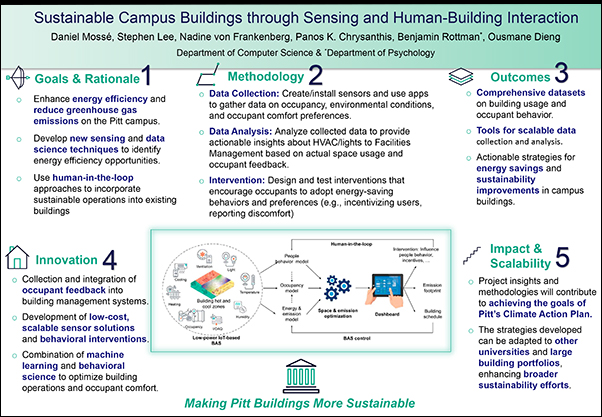
Image:
One side of image illustrates "Low-power IoT-based BAS" in a circle with "Building hot and cool zones" at its center. Around the edges: Cooling, Ventilation, Light, Temperature, Humidity, I/OAQ, Occupancy, Heating.
From this section, arrows point to a center section with phrases stacked from top: "People behavior model," "Occupancy Model," and "Energy and emission model." Arrows also point from top and bottom phrases to "Occupancy model" at center.
Arrows from all three phrases in the center point to next image of gears labeled "Space & emission optimization," which points next to hands on a control screen of a tablet labeled "Dashboard. " From Dashboard, arrows point to the top right "Intervention: Influence people behavior, incentives, ...", to bottom right "Building Schedule" and straight ahead to "Emission Footprint"
The "People behavior model," and "Intervention: Influence people behavior, incentives, ..." concepts at the top are linked with a "Human in the loop" label. The "Energy & Emission Model" and "Building schedule" concepts at the bottom are linked by a "BAS control" label.